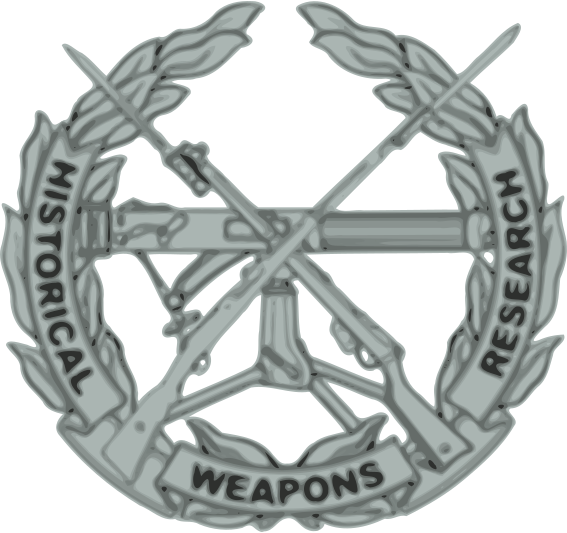
The Historical Weapons Research Group portrays members of No. 20 Weapons Technical Staff (WTS) and No. 2 Operational Research Section (ORS), who were attached to the HQ of 21 Army Group circa June 1944 — May 1945, including members of the Small Arms School Corps, the Royal Artillery, the Intelligence Corps and other specialists. Their role was to gather as wide a range of weapons, Allied and Axis, in order to undertake assessments of them, including operational research as to the effectiveness of enemy weapons and how to counter them.
Our display includes a wide range of deactivated weapons, including firearms, mines, munitions, clothing and equipment, much of it original, that was used by soldiers from 1914 to 1945.
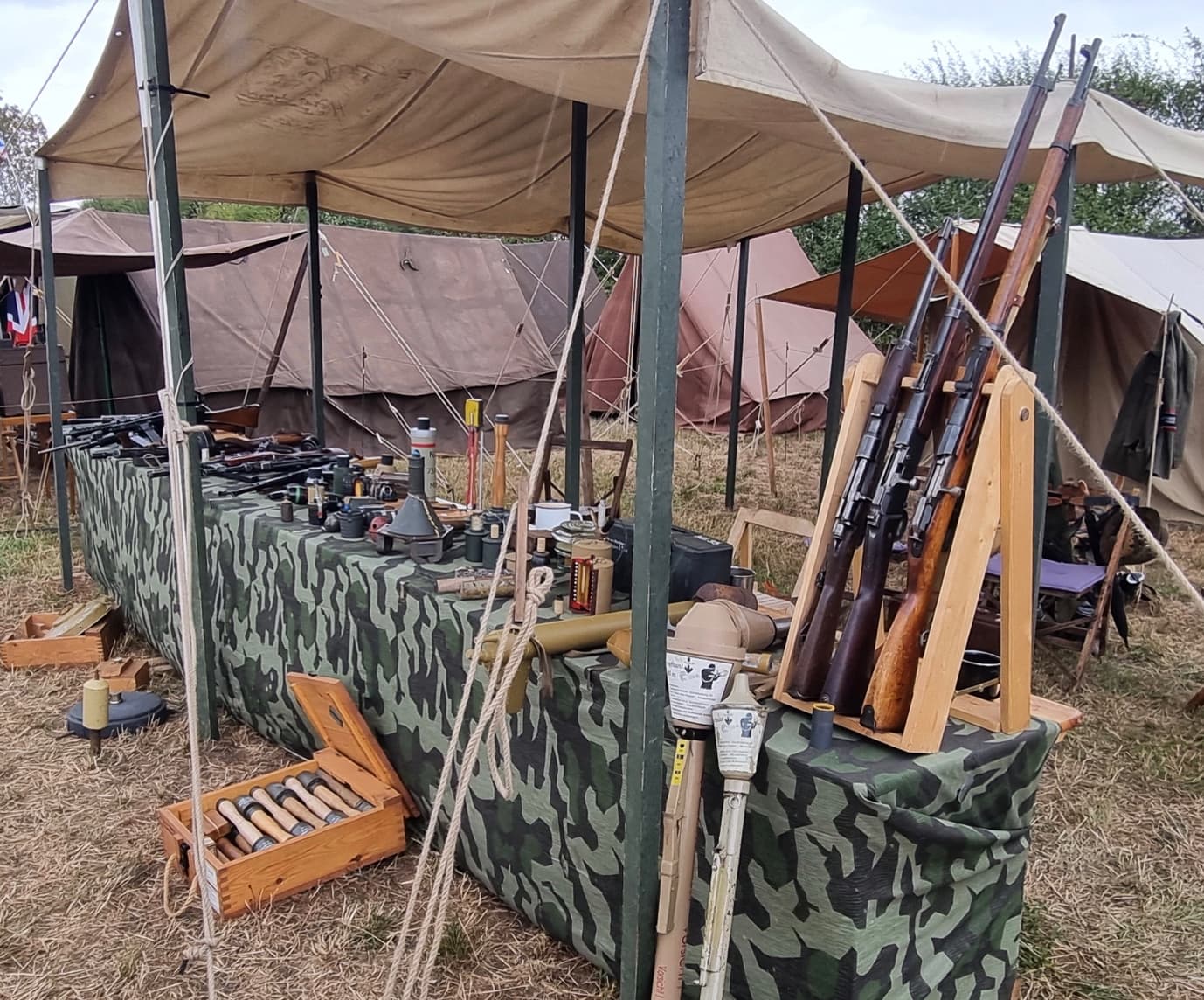
The group has a wide array of original weapons, British, German and Russian, including rifles, machine guns, pistols, grenades, infantry anti-tank weapons and mines from 1900 through to 1945. We offer the public the opportunity to see the development of infantry weapons through both world wars, including the bolt action rifle, the machine gun, the sub-machine gun, pistols, grenades and the infantry man’s anti-tank weapons.
Our collection
Our current list of weapons and equipment we display, which is being added to all the time, is as follows:
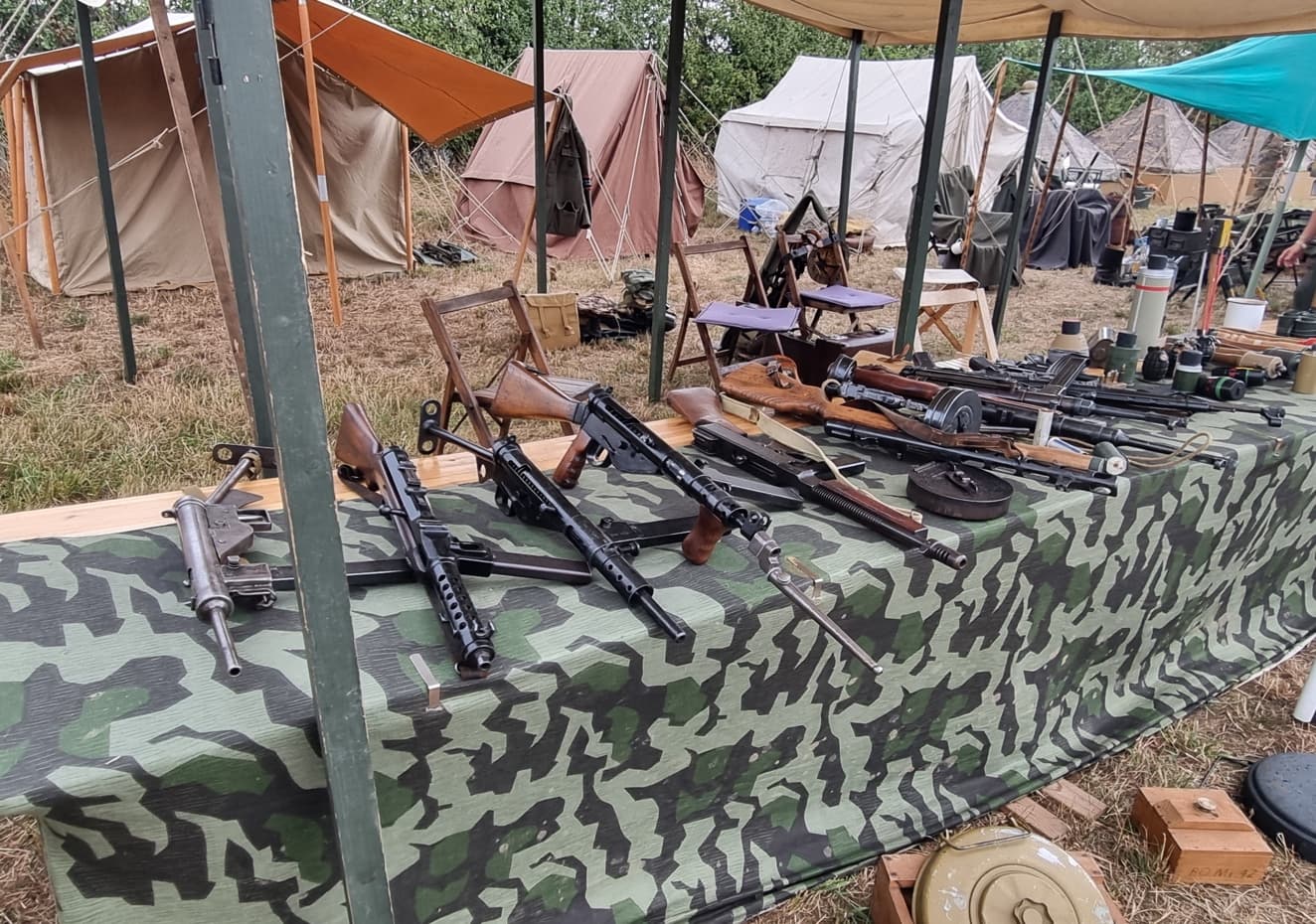
Sub-machine guns and sidearms
- MP34, MP40, MP41;
- 2x Stens - Mark 2 and Mark 5, MP3008 (German copy of the Sten),
- PPS41, Thompson, US BAR. Pistols include long barrel Luger and trommel mag, plus a short barrel Luger, a C96 Broom Handle and P38.
Rifles
- A Mauser 1871 Jaegerbusch. The first Mauser rifle in German military service. Followed by the Mauser 1871/74 - the magazine variant of the above M1871.
- The 1888 Commission Rifle - the first German “smokeless” powder Rifle - introduced to counter the French Lebel, which was the world’s first smokeless powder rifle. (Our group has one of those too).
- Then the Gewehr 98 (1898): the first of the 98 family…
- Next the Karabiner 98AZ (the carbine version of the G98, introduced 1908).
- Finally the Kar98 Kurz from 1935-45.
- A French Lebel, plus an Italian Carcano carbine and a Russian Moisin-Nagant.
- A StuG 44 (replica).
Members of the group interact with the public, portraying soldiers of the Small Arms School Corps, Royal Artillery, Intelligence corps and other specialist circa 1944 — 1945, explaining the development and use of small arms, anti-tank weapons and other categories of weapons in use between 1914–45, but with a specific focus on the end of the Second World War. As part of this, members demonstrate (from within the parameters of our display area), the range of small arms, machine guns and infantry anti-tank weapons used by soldiers, albeit this does not involve any discharge of such as all original weapons used and on display are deactivated to UK requirements.
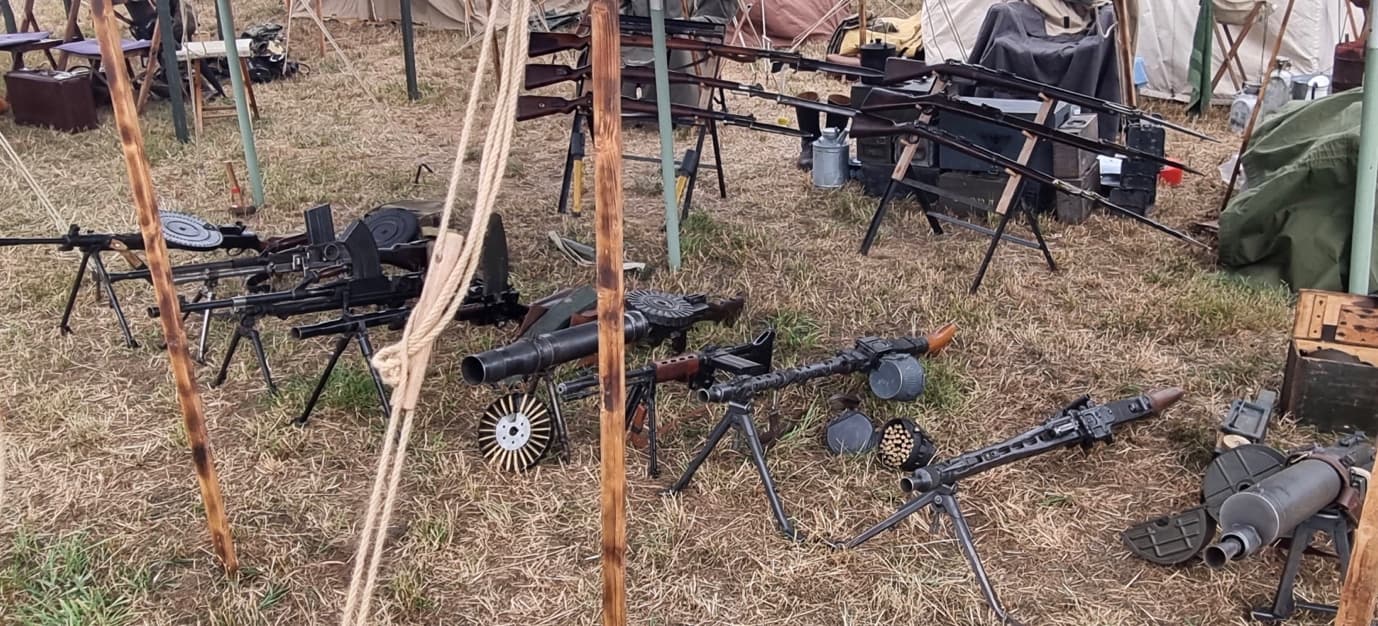
Members of the group provide talks on various of the weapons, their evolution and use. These talks initially revolve around a unique collection of machine guns, including an original MG08, Vickers MG, Lewis Gun, Bren Gun, Madsen, ZB26/30, DP27/28, MG34 and MG42. Members can explain to the public the evolution of both the technical and tactical story of the machine gun. We can also explain the story of the evolution of the infantry anti-tank weapon, from the First World War German anti-tank rifle, the Tankgewehr, through to the Piat, Panzerfaust and Panzerschreck, comparing the British, American and German anti-tank weapons of the Second World War.
To understand our portrayal, it is critical to understand the very poorly documented process of weapons testing and procurement. The Ministry of Supply, (MoS) which was formed in 1939, was based at Shell Mex House on the Strand in London. It was responsible for, among other things, building and running Royal Ordnance Factories, producing explosives and propellants, constructing guns and rifles, and supplying the myriad of other materiel that an army of millions would require daily. The MoS’s responsibilities also covered tanks and armoured fighting vehicles, and the fuel required to operate them. The Ministry also took over all army research establishments in 1939.
One of the MoS’s departments was the Weapons Technical Staff (WTS) who were responsible for testing and reporting on both British and enemy weapons. Whilst many of the WTS were based in Britian, there was the Weapons Technical Staff, Field Force (WTSFF). Their role was to go out to theatres of war, collect, test and report on enemy weapons, evaluating them against British weapons. These reports were vital to the MoS in informing weapons development.
The WTSFF operated in Tunisia in 1943, Italy 1943–45 and in NW Europe. For example, in early 1943 Captain (some sources state he was a Major) F W Burton of the SASC, who was responsible for testing the PIAT on the first captured Tiger Tank (not Tiger 131) in Tunisia. Crucial to this was Lieutenant-Colonel Jocelyn Barlow (initially in charge of Staff Duties 5, later Weapons Technical Staff, Field Force) of GHQ, MEF, who was Director of Artillery Small Arms in the Ministry of Supply, Artillery Division. He had previously been the Officer for Technical Duties at the Netheravon Wing of the Small Arms School Corps between 10th October 1928 and 17th December 1931. Barlow was an inspector of enemy weapons and armoury, and in 1942 he had was consequently responsible for providing non-standard weapons (German) to the Long Range Desert Group (LRDG), yes, the origins of the SAS. He served in both Tunisia and Italy 1942-45 and was accompanied by several SASC NCOs.
In June 1944 a WTSFF was attached to 21st Army staff in Normandy. Number 20 WTSFF included a specific small arms technical staff under Lieutenant Colonel T R Henderson. The WTSFF were joined by Number 2 Operational Research Unit. They included a wide variety of services, from the SASC through the RA, RAOC, REME, and the Int Corps.
However, the story begins in Tunisa in February 1943.
On 31st January 1943 a mixture of German tanks, led by a Tiger I and with another Tiger a short way back, were advancing along the Robaa Valley when they were ambushed by six pounder Mark II anti-tank guns of No. 2 Troop, of A Battery, 72nd Anti-Tank Regiment, Royal Artillery. Two guns took on the leading Tiger, which they penetrated from the side, the accompanying Panzer III N (four of them) were then knocked out, while the fourth gun, in company with two six-pounders of No. 1 troop tackled the second Tiger, and having penetrated its armour five times put it out of action as well. Since it was near the back of the group the Germans were able to use a Panzer III to tow it away. The first Tiger, however, was in an area dominated by the British and under heavy artillery fire so it had to stay where it was, in any case it was on fire with some crewmen killed, some captured and the others making their way back to German lines.
It is claimed that the 17th/21st Lancers tried to tow it away but were unable to, since, according to the Germans it was burning for three and a half hours this is hardly surprising. At one point, while the Tiger was still intact, a Valentine of 17th/21stLancers, 6th Armoured Division, attempted to squeeze past it, but in doing so ran over an anti-tank mine, which damaged the off-side track and brought it to a halt.
As to what happened next, each side had distinct claims. German sources claim that because they were unable to recover the damaged tank a pioneer sergeant-major was sent down at night with a 50-kilogram charge and that he managed to blow the tank up. The British claim that since they could not tow the tank away and because it was believed that the Germans would attempt to recover it the Royal Engineers were given the task of blowing it up.
It is not possible to say who is telling the truth. For a German NCO to creep down in the dark would require a great deal of pluck, and even a bit of luck, but it’s not impossible. On the other hand, assuming that they were available, there would be nothing to stop a party of Sappers from approaching the tank and blowing it up. The end result was that the Tiger tank was effectively wrecked and burnt out, which is why it was not recovered. In April, Tiger 131 was still running when its crew fled, and the British seized it.
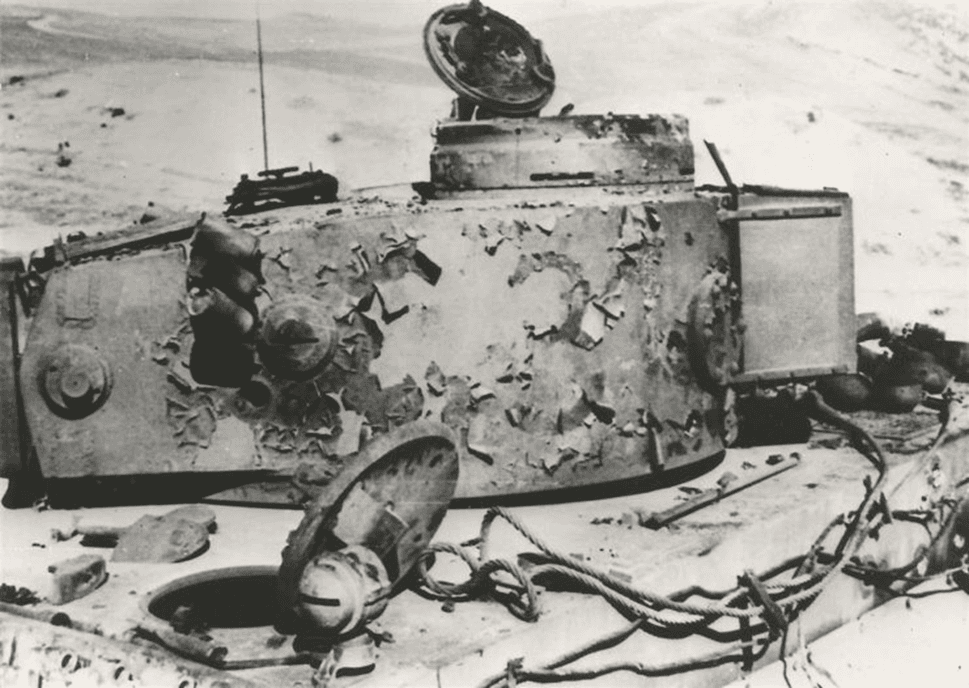
On 2nd February, Major J. A. Barlow and Lieutenant-Colonel R. D. Neville of the Weapons Technical Staff of the Field Force visited 18 Army group in Tunisia. They arrived to carry out tests. The pair spent their time measuring the thickness of surviving armour and salvaging pieces of metal to be sent back to Britain for evaluation.
While Major Barlow, after a few days, set off in a car with the first pieces of the tank selected for investigation, Lt-Col Neville remained with the tank. His brief was to acquire portions of the thicker frontal armour and, if possible, carry out firing trials against it. Unfortunately, the oxyacetylene cutting gear ordered to hasten this process never arrived. It got no nearer than Robaa, where the lorry carrying it was stopped since it was considered too large to enter the area. As a result, Neville was reduced to using explosives to break off the sections he wanted; a photograph taken afterwards shows the tank with no hull front at all, but instead with the final drive exposed.
Firing at trials revealed that a six-pounder anti-tank gun, firing at 300 yards, could damage the front plate but not make a hole right through it, although firing at the front of the tank was not considered a good idea, the flanks were much more vulnerable. In due course chunks of armour from the front of the hull were recovered to be air-lifted back to Farnborough, along with a sample track link. Whether a lot of use was made of them is another matter, although a lot had been learned about the tank from inspecting the wreck.
This is a typical example of the work of the Weapons Technical Staff of the Field Force. Building on their work in Tunisia and later Italy, No.20 Weapons Technical Staff Field Force were attached to the HQ of 21st Army Group, NW Europe from June 1944 in Normandy until the end of hostilities in 1945, who also hosted No.2 Operational Research Section.